
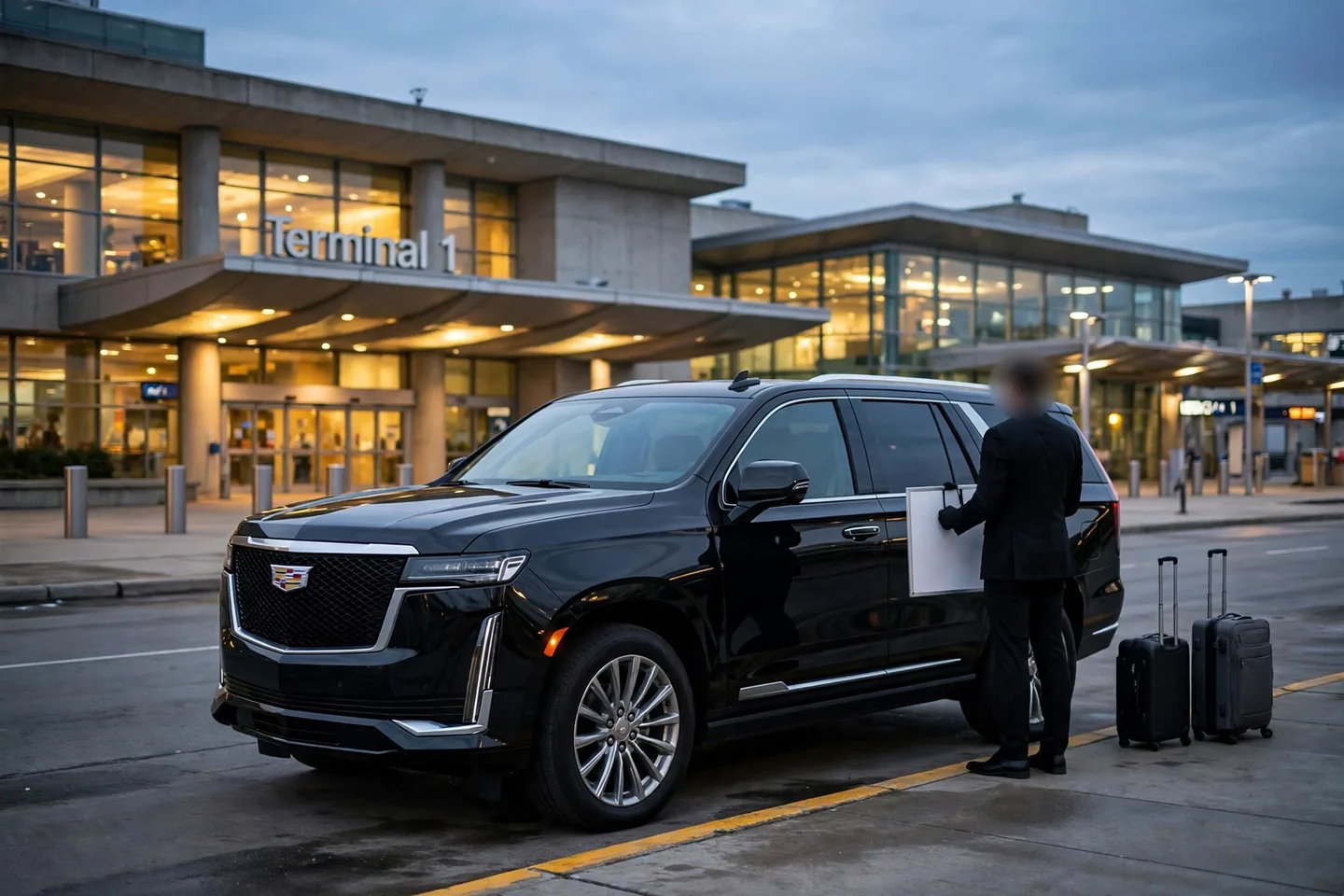
You have just landed at Toronto Pearson Airport, and the first decision of the trip home is waiting before you have even collected your bags: limo, Uber or taxi? All three will get you to Vaughan, downtown Toronto or anywhere else in the GTA — but they work very differently. One is booked before you fly, one is summoned from an app at the curb, and one is waiting in a line outside arrivals. Which one wins depends on your flight, your luggage and your schedule, and this guide lays out the honest answer.
The three ways home from Pearson
Every arrival at Pearson faces the same three choices, and each one suits a different kind of trip. A pre-booked limousine is arranged before you fly: your chauffeur tracks your flight and meets you at Door A with a name sign. Uber or another rideshare is requested from your phone once you land, and you walk to a designated pickup zone to meet your driver. A licensed airport taxi is waiting in the queue outside the arrivals level — you simply join the line and take the next cab.
None of these is the wrong answer. The right one depends on what matters most on the day: the lowest possible fare, the shortest wait, the most space, or the most certainty. A solo traveller with a carry-on at two in the afternoon has a very different trip from a family of five landing at midnight with six suitcases.
This guide compares the three on the things that actually shape the ride: how you book, where you meet your car, how the price is set, what happens when your flight is delayed, and how much help you get with your luggage.
Booking: planned in advance or decided at the curb
A limousine is the only option of the three that is fully arranged before you leave home. You book online or by phone, choose your vehicle, and your pickup is confirmed with a fixed rate before you fly. There is nothing to arrange when you land — your chauffeur is already assigned and already watching your flight.
Uber works the other way around. You request the ride after you land, and the app matches you with the nearest available driver. That flexibility is the whole point of rideshare, and on a quiet day it works beautifully. But at a busy hour — a wave of flights landing at once, a Friday evening, a snowstorm — the wait can stretch, and the driver assigned to you may still be finishing another trip.
A taxi needs no booking at all. Licensed cabs queue outside both terminals, and the line usually moves quickly. At peak times, though, the queue grows with every arriving flight, and on the busiest nights it can stretch well past the terminal doors. If you value not thinking about transport until you are standing at the curb, the taxi line is simple — just be ready to wait when everyone else has the same idea.
Where you meet your ride at Pearson
Where you meet your car matters more than most travellers expect, especially with luggage or children in tow. Here is how it works at each terminal:
- Pre-booked limousine: your chauffeur meets you inside the terminal at Door A on the arrivals level, at both Terminal 1 and Terminal 3, holding a name sign. The vehicle is staged nearby, ready to load and go.
- Uber and rideshare: at Terminal 1 you head down to the ground level and out to Door Q, where the rideshare pickup zones are. At Terminal 3, rideshare pickups are on the arrivals level, in the signed zones outside Doors B and D. Check the app for your assigned bay — it changes with demand. (Uber Black pickups are the exception: they meet at Door A, like a pre-booked car.)
- Airport taxi: licensed cabs wait in the taxi line at the arrivals curb of each terminal. Follow the signs from baggage claim and join the queue.
That walk to the rideshare zone is worth thinking about in winter, with heavy bags, or with small children. Door A is the shortest route out of the terminal; the ground-level pickup zones add a level change and a longer walk. For an elderly parent or a traveller with mobility needs, meeting your chauffeur inside the terminal is a genuine comfort, not a luxury.
How the price is set — and why it changes
The biggest difference between the three options is not how much they cost on a quiet day, but how predictable the price is when conditions change.
A pre-booked limousine is a fixed rate agreed when you reserve. Your exact quote is shown instantly on the reservation page before you commit, and the price does not move for traffic, weather, a delayed flight or a surge in demand. What you are quoted is what you pay.
An airport taxi runs on the airport's published flat-rate zone system: the fare is set by your destination zone, so a cab to Vaughan costs the same whether the 401 is clear or crawling. There is no surge pricing, and the fare is the same no matter which cab you take. It is a fair, predictable system — the trade-off is that you cannot choose your vehicle, and the fare is set at the curb rather than agreed in advance.
Uber is the only one of the three with dynamic pricing. The fare you see in the app is set by live demand, and it can rise sharply when many flights land at once, when it snows, or when drivers are scarce. The same trip can cost noticeably more at 6 p.m. on a Friday than at 2 p.m. on a Tuesday. On a quiet day rideshare is often the cheapest car on the road; on a busy one it can be the most expensive — and you only find out when you open the app.
One more thing worth knowing: when the fare is split across several people, the comparison changes. A family of five in one SUV pays one fixed rate. The same five people in rideshare need two cars, and in a taxi they may not all fit with their luggage at all.
What happens when your flight is delayed
Flights into Pearson are delayed more often than anyone would like — winter weather, de-icing holds, late inbound aircraft. How each option handles a delay is where a pre-booked limo earns its keep.
Your chauffeur tracks your flight from departure to landing, so a delay is already known before the aircraft touches down. The pickup simply moves with your actual arrival time. There is no need to call from the plane, no rebooking, and no charge for waiting when the delay is the airline's.
With Uber, a delay costs you nothing directly — you simply request the car when you actually land. But you also start from scratch: opening the app at the new arrival time, in whatever demand conditions exist then. A flight delayed into the evening rush can mean a longer wait and a higher fare than the one you would have seen at the scheduled time.
A taxi is the most delay-proof option of all in one sense: the cabs are always there, whenever you land. You will never be stranded without a car. The trade-off is the queue — a delayed flight that lands alongside three others means a longer line.
Vehicle, space and luggage help
With rideshare, the car you get is the car that accepts your request. A standard Uber is a regular sedan, and whether it fits your luggage depends on what arrives. Larger options exist, but availability varies by the hour, and you cannot guarantee a specific vehicle in advance.
An airport taxi is also whatever is next in the line — usually a sedan, sometimes a van. Most cabs take three passengers comfortably; four or more passengers, or four or more large suitcases, can be a squeeze, and the driver may suggest a second cab.
With a pre-booked limousine, the vehicle is chosen when you book, sized to your party and your luggage. A sedan suits one or two travellers with a few cases; an SUV carries a family of up to six with room for the bags that come with them; larger groups travel together in a van or stretch limousine instead of splitting across two cars. And the chauffeur loads the luggage — a small thing after a long flight, and a big one when the bags are heavy or the weather is foul.
Families with car seats, travellers with skis or golf clubs, and anyone with oversized luggage should mention it when booking. A vehicle that is ready for your bags beats one that is not.
When each option wins
Here is the honest summary. Uber wins for a solo traveller or a couple with light luggage, landing at a quiet hour, heading somewhere close — downtown, Mississauga, Etobicoke. At a calm time of day it is quick, flexible and often the cheapest ride available. It also wins when plans change at the last minute and you need a car with no notice.
The taxi line wins for a short hop with no booking and no app — an airport hotel, a quick trip nearby, or a traveller who simply wants the next available car. It is simple, it is always there, and the flat zone fare means no surprises.
A pre-booked limousine wins when certainty matters more than anything else: families and groups, lots of luggage, early-morning departures before dawn, late-night arrivals, business travel with an expense report to file, and any trip where a delay or a surge would cause real trouble. It also wins on the long runs — Vaughan, Oakville, Burlington, Niagara — where a driver committed to the trip in advance beats hoping one accepts it at the curb.
The pattern is simple: the more people, the more luggage, the earlier or later the flight, and the longer the drive, the more a pre-booked limo makes sense. The lighter the trip and the quieter the hour, the more the app or the taxi line will do.
| Pre-Booked Limo | Uber / Rideshare | Airport Taxi | |
|---|---|---|---|
| Booking | Reserved in advance, online or by phone; vehicle chosen when you book | Requested from the app after you land; matched to the nearest driver | No booking — join the queue at the arrivals curb |
| Pickup | Chauffeur meets you inside at Door A, Terminal 1 and Terminal 3, with a name sign | Designated pickup zones — Terminal 1 ground level at Door Q; Terminal 3 arrivals level outside Doors B and D | Taxi line at the arrivals curb of each terminal |
| Pricing model | Fixed rate agreed when you book; quoted instantly on the booking page; never changes for traffic, weather or delays | Dynamic — the fare moves with live demand and can rise sharply at busy times | Flat rate by destination zone, set by the airport; no surge, same fare from any cab |
| Vehicle | Your choice — sedan, SUV, van or stretch limousine, sized to your party | Whatever accepts your request; larger options available but not guaranteed | Next cab in the line, usually a sedan |
| Flight tracking | Yes — chauffeur follows your flight and adjusts the pickup to your actual arrival | No — you request the car when you land, in whatever conditions exist then | Not needed — cabs are always waiting, whenever you land |
| Luggage help | Chauffeur loads and unloads; vehicle sized to your bags in advance | Varies by driver; no guarantee of help or space | Driver usually helps, but space depends on the cab that arrives |
Frequently asked questions
Is a limo from Pearson more expensive than Uber?
On a quiet day, rideshare can be the cheapest option. At a busy hour — a wave of flights landing, bad weather, a Friday evening — dynamic pricing can push an Uber fare well above a fixed limo rate. A pre-booked limousine is a fixed rate agreed before you fly, so it never changes, whatever the conditions. The fair comparison is not one fare against another, but a fixed rate against a fare that moves.
Where do I meet my Uber at Toronto Pearson?
At Terminal 1, head down to the ground level and out to Door Q, where the rideshare pickup zones are. At Terminal 3, rideshare pickups are on the arrivals level in the signed zones outside Doors B and D. Check the app for your assigned bay. Uber Black pickups meet at Door A, the same as a pre-booked limousine.
Where do I meet my pre-booked limo at Pearson?
At Door A on the arrivals level, at both Terminal 1 and Terminal 3. Your chauffeur waits there with a name sign, and the vehicle is staged nearby.
Which is best for a family landing at Pearson?
For a family with children and several suitcases, a pre-booked SUV usually wins: one vehicle, room for everyone and their bags, a chauffeur who loads the luggage, and a fixed rate agreed before you fly. A family of five in rideshare needs two cars, and a single taxi rarely fits the whole party with their luggage.
However you choose to travel, the best ride from Pearson is the one that fits your trip — your flight, your luggage and your schedule. If that sounds like a car waiting for you at Door A, with a fixed rate agreed before you fly and a chauffeur tracking your flight, book your Pearson pickup online and see your instant quote before you commit. Your chauffeur will be waiting when you land.