
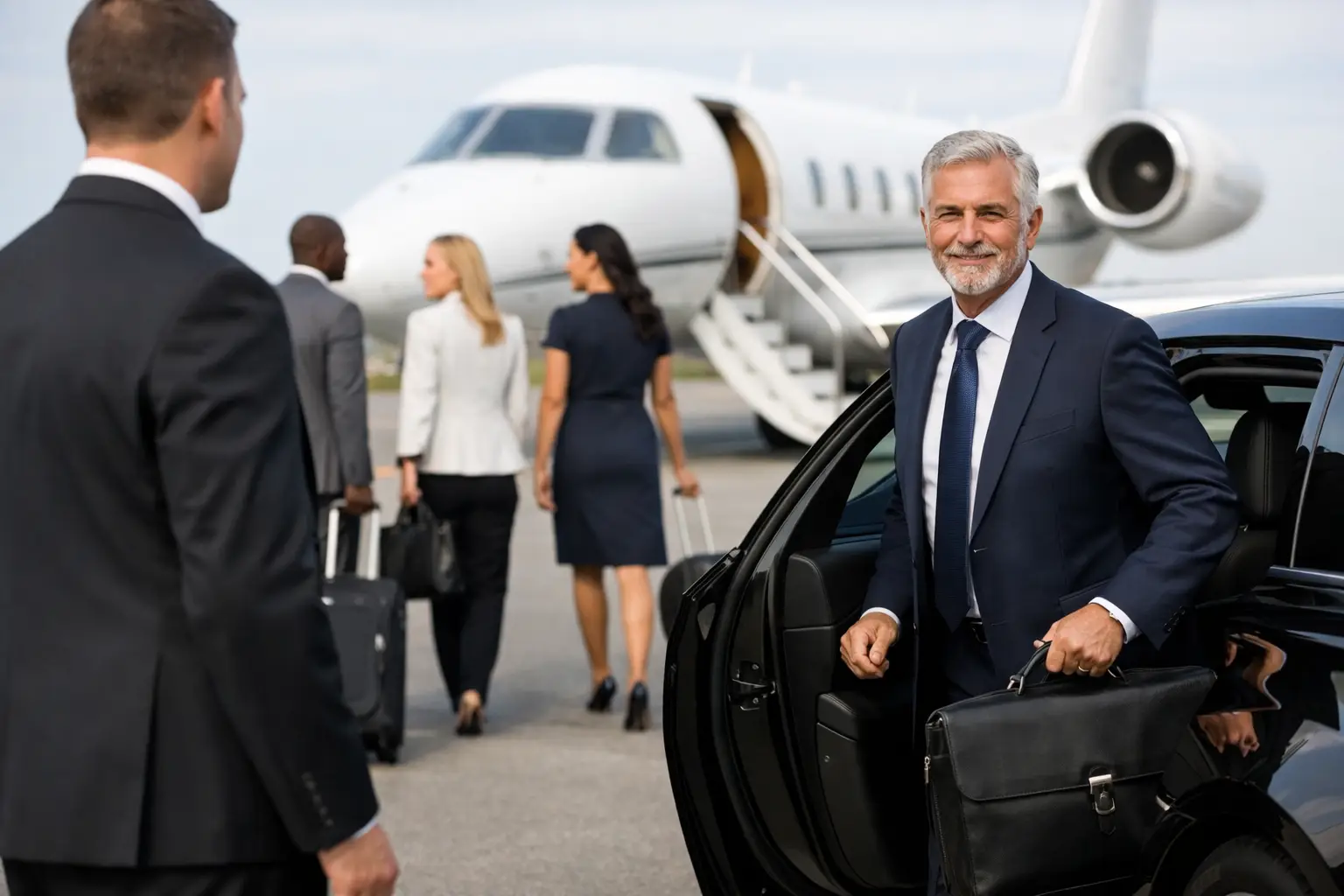
A six-person delegation was arriving at Toronto Pearson on separate flights, meeting a Canadian leadership team downtown, visiting a Vaughan facility, and departing within 30 hours. This executive delegation transport case study examines the practical details behind a successful chauffeur plan: not simply placing vehicles at the curb, but protecting a schedule where one missed connection could affect every meeting that followed.
The following is a representative, anonymized scenario based on the needs commonly seen in executive group travel. The client required discretion, punctuality, clear reporting, and one point of contact from arrival through departure.
The Assignment: More Than an Airport Pickup
The delegation included senior leaders, an interpreter, and a local host. Two guests landed at Pearson Airport in the early morning, three arrived from the United States just after noon, and one arrived later that evening. The next day involved a hotel departure, a boardroom meeting in Toronto, a site visit in Vaughan, and a working dinner before an early airport return.
A standard point-to-point booking would not have addressed the real risk. Flight timing could change. Guests unfamiliar with the GTA could be delayed at customs. Luggage collection might take longer than expected. Most importantly, the delegation needed to arrive calm, prepared, and on time rather than managing calls, directions, and ride availability between meetings.
The transport plan therefore had to account for more than distance. It had to support the entire business itinerary.
Executive Delegation Transport Case Study: The Plan
The first decision was fleet selection. A luxury SUV was assigned to the principal executive and local host, while a premium van was reserved for the remaining guests and their luggage. This configuration kept the group coordinated without forcing every traveller into one vehicle. It also gave the host a private setting for briefing the principal before the first meeting.
The operational brief covered four areas:
- Flight monitoring and meet-and-greet instructions for each arrival
- Vehicle assignments, passenger names, and luggage expectations
- Hotel, meeting, facility, and restaurant pickup windows
- A single dispatch contact for the client’s executive assistant
Each chauffeur received a route plan, guest protocol, and updated contact procedure. The executive assistant did not need to message multiple drivers or explain itinerary changes repeatedly. One transportation coordinator managed the moving parts and confirmed status at each key stage.
That structure matters when the schedule is compressed. A vehicle can be immaculate and still fail the assignment if the chauffeur has not been briefed on the correct terminal, guest name, meeting entrance, or contingency process.
Arrival at Pearson Airport
The first challenge came before the delegation had formally assembled. One inbound flight arrived early, while another was held at the gate due to an airport operations delay. Rather than treating both travellers as ordinary curbside pickups, the chauffeurs adjusted their timing through flight monitoring and remained in contact with dispatch.
Meet-and-greet service reduced uncertainty for the guests. They were met with clear identification after arriving in the public area, assisted with luggage, and escorted to their assigned vehicles. For executives who have just completed a long international flight, this small detail changes the first impression of the visit. There is no searching for a pickup zone, checking a phone in a busy terminal, or wondering whether the vehicle has arrived.
The early-arriving guest was transferred directly to the hotel, while the delayed travellers were collected without requiring the local host to wait at the airport. The host received concise updates instead: guest met, guest en route, estimated hotel arrival. That preserved the host’s time and prevented the arrival process from becoming a distraction.
Managing the Day Between Meetings
The following morning, the delegation faced the most demanding portion of the itinerary. A downtown meeting had a fixed start time. The Vaughan facility visit depended on the boardroom session ending close to schedule, and the dinner reservation allowed little flexibility.
The value of dedicated executive transportation became most visible in the transitions. Chauffeurs arrived ahead of each scheduled departure, confirmed passenger readiness through the designated contact, and positioned vehicles close to the appropriate entrance. The group did not need to split into separate app-based bookings or account for drivers unfamiliar with the itinerary.
During the first meeting, the client requested a minor change: the principal executive needed an additional 20 minutes of private discussion with the Canadian host before the facility visit. Because the SUV and van were assigned for the day rather than booked as isolated rides, the adjustment could be accommodated without rebuilding the entire plan.
There is a trade-off here. Dedicated vehicles and chauffeurs cost more than treating each journey as a separate transaction. For an informal outing with flexible timing, that may not be necessary. For a visiting executive group, the additional control often protects far more valuable resources: meeting time, professional credibility, and the attention of senior people.
Privacy Was Part of the Service
Executive travel is not only about getting from one address to another. Conversations often continue in the vehicle. Guests may review briefing materials, take calls, or discuss commercially sensitive information between appointments.
The chauffeurs’ role was therefore deliberately professional and restrained. They assisted with doors and luggage, confirmed the next destination when appropriate, and maintained a quiet, respectful cabin environment. No unnecessary conversation, no request for itinerary details from guests, and no casual discussion of other passengers.
Vehicle choice also contributed to privacy. The principal travelled with the host in a separate SUV for portions of the schedule where confidential discussion was expected. Meanwhile, the wider delegation used the van, which allowed them to remain together and prepare for the next engagement. The plan balanced group cohesion with the need for confidential conversations.
What Could Have Gone Wrong
The itinerary succeeded because it was built around probable pressure points, not because every detail unfolded perfectly. Toronto traffic, weather, event congestion, and airport variability can affect even the best-planned schedule.
In this case, the primary risk was the handoff from the downtown meeting to the Vaughan visit. Had the first session run significantly over time, the group could have arrived late despite efficient driving. The coordinator addressed that risk in advance by building a realistic buffer into the route plan and identifying the correct facility entrance before the day began.
The second risk was luggage capacity. Executive delegations often travel with presentation materials, samples, or more baggage than a typical airport passenger. Confirming this at booking prevented an unsuitable vehicle assignment and avoided last-minute rearrangement at Pearson.
The third risk was communication overload. When six guests, a host, an assistant, and multiple chauffeurs all exchange messages independently, small updates can be missed. The single-contact model kept communications clear. Guests were not asked to manage transport decisions, while the assistant could make changes through one accountable channel.
Results That Matter to the Client
The delegation reached each scheduled engagement without a missed appointment. All airport arrivals were met, the hotel transfers were completed without the host leaving the office, and the group travelled together for the facility visit. The principal and host also had private travel time when it was most useful.
Just as important, the transportation experience did not become a topic of concern for the visiting guests. That is usually the right outcome. Executive ground travel should feel organized and unobtrusive, allowing the client to focus on relationships, negotiations, presentations, and decisions.
Fixed-rate planning also gave the organizing team greater cost clarity. With the itinerary, vehicle requirements, and service windows established in advance, there was less exposure to unpredictable pricing at critical moments. For corporate accounts and meeting planners, that visibility can simplify approvals and post-trip reporting.
Lessons for Planning Executive Delegation Travel
The strongest plans begin with the itinerary, not the vehicle. A sedan, SUV, luxury van, or shuttle may all be appropriate depending on passenger count, luggage, privacy needs, and whether the group must travel together. The right choice depends on the purpose of the trip as much as the number of seats required.
It is also wise to share the details that can change service quality: flight numbers, terminal expectations, guest names, hotel entrances, meeting timing, luggage volume, and the name of one authorized decision-maker. These details allow a chauffeur team to act proactively rather than react after a delay has already become a problem.
For airport arrivals, meeting days, client visits, and out-of-town transfers across Toronto and the GTA, Fly Limousine Services approaches executive delegation travel as a coordinated service assignment. Professional chauffeurs, suitable luxury vehicles, 24/7 availability, and fixed-rate planning provide a dependable framework when timing and presentation matter.
The most useful closing thought is simple: when a delegation is carrying an important business relationship, transportation should not be left to chance. Plan the handoffs as carefully as the meetings, and your guests can spend their attention where it belongs.